- Rock Chasing
- Posts
- It's raining garnets! - 4/17/24
It's raining garnets! - 4/17/24
Hello rockhound,
As the weather continues to warm up I’m spending more and more time out exploring and seeing some great results. I hope you have too!
It’s been fairly rainy here and that has revealed a lot of beautiful rocks and minerals in some of my favorite spots. Rockhounding after a good rainstorm is my favorite time.
One quick request, could you reply to this email and tell me what your favorite rock or mineral is that wasn’t in last week’s poll?
We had a lot of great submissions from our poll last week (details below) but I want to know what I missed including!
This week we cover
A giant amethyst and jade formation
Some incredible garnets and how to spot them
The beautiful folds of Canada
Using backlights to find better success
How to avoid getting duped with rubies
Much more!
Happy rockhounding!
Keith
A little sparkle to start
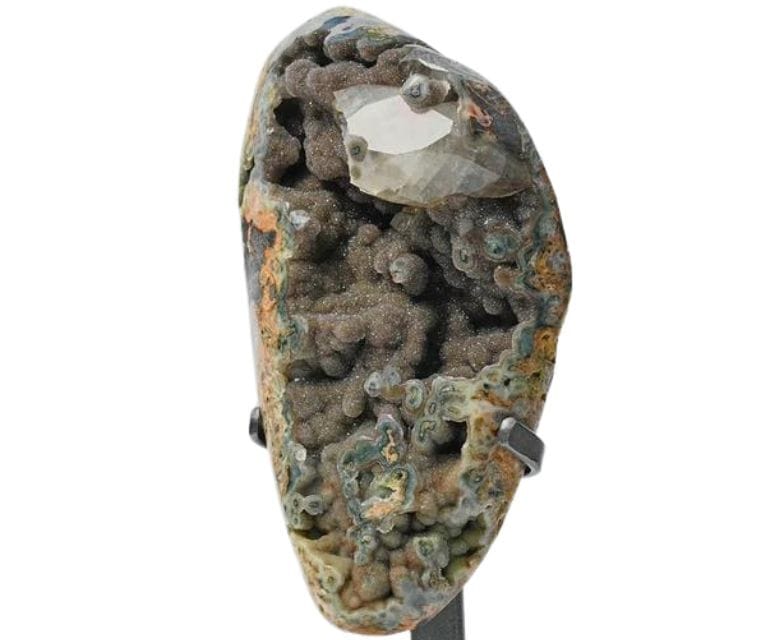
It’s rare to find such a beautiful specimen with so much going on! This whopping 10-pound find is a combination of Amethyst and Jasper.
There is so much going on with this that it’s hard to choose what to talk about!
Found in Uruguay, a country known for having some incredible amethyst, Amethyst is a purple variety of quartz, colored by iron impurities and irradiation, giving it a distinctive hue.
Jasper, on the other hand, is an opaque form of chalcedony, composed of microcrystalline quartz mixed with other minerals, which create its earthy green colors and patterned appearances.
You can find out more about this find or add it to your collection here.

Poll Results

Favorite Rock Or Crystal Poll Results
We had a TON of you respond to our poll last week and the results are in! As you can see above, we have a lot of community members who love agates and amethyst (who doesn’t).
They were the clear favorites but there was still a lot of love for the rest of the list.
I know I missed a lot of rocks and minerals on the list so let me know what your favorite is that I didn’t include.
Reply to this email and tell me! I love hearing from you.
Other people won’t understand….

I’m in this photo….
Find of the week

It’s raining garnets…
If you’re looking for garnets then upstate New York looks like the place to be. Look at all the beautiful garnets that were found on a rainy day!
These garnets were found near Barton Mines at an elevation of around 2,600 feet. Not the easiest spot to get to but worth the trip!
Garnets are a group of silicate minerals with similar crystal structures but different chemical compositions. Each type has its own unique properties and colors.
Send me photos of your rocks and minerals!
I want to see what you’re finding and adding to your collection! Send me photos of the rocks and minerals that you’re discovering in your rockhounding journey or bought and added to your collection so I can share it with the community.
Send your best photos and descriptions to [email protected] or just reply to this email!
Geology Highlights

Garnets are one of the most diverse and beautiful geological formations that you can find. There are so many different garnet colors and varieties out there.
As I mentioned above, garnet varieties all share a similar crystal structure but can vary quite a bit when it comes to chemical composition and properties. How much garnets are worth can also vary wildly!
Andradite garnet, like in the photo above, is known for its ability to refract light which makes it look very shiny. This property, plus its beautiful black color and hardness, makes it very popular for jewelry

Community Tips

Put a little salt in your spray bottle
This week’s tip comes from Bobby in Bangor Maine:
We all know that a spray bottle is an essential piece of rockhounding equipment. It’s starting to warm up now, but if you’re planning to do any rockhounding in the cold mornings try putting a little bit of salt into your spray bottle.
Nothing is more frustrating than trying to use your spray bottle to remove dirt from a rock you found only to find it frozen solid!
Adding a little salt will reduce the freezing point of the water in the bottle and won’t harm most of the rocks and minerals your cleaning up.
Bobby
Every week one of our members shares a valuable tip or a big mistake they've made in their rockhounding journey. If you have a tip or mistake you'd like to share email us at [email protected] or just reply to this email!
Geology highlights

There are several really interesting rocks and minerals that will glow under black light (UV light). This phenomenon, called fluorescence, occurs when certain minerals within the rocks absorb the invisible UV light and then emit it as visible light.
The process involves electrons in the mineral's atoms absorbing energy from the UV light, which excites them to a higher energy state. When these electrons return to their normal state, they release energy in the form of light, which we see as glowing.
The specific colors of the glow depend on the mineral composition of the rock and it is a very useful tool when trying to identify various rocks and minerals.
Rockhounding
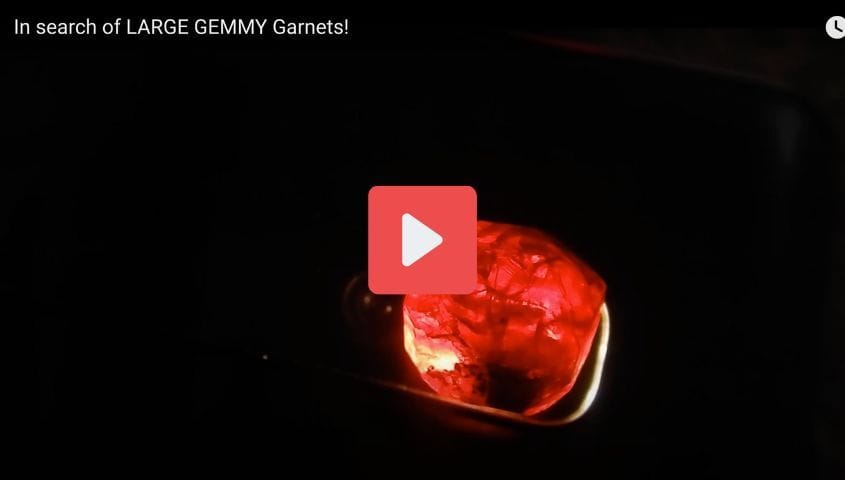
Continuing on our Garnet theme, this is a great video from Dan Hurd on the process of finding Garnets. The video is shot in Canada but the process of finding and identifying garnets he uses can be used just about anywhere garnets are found.
Check out the video if you want to make sure you’re not missing any garnets when you’re out rockhounding.
Geology Highlights
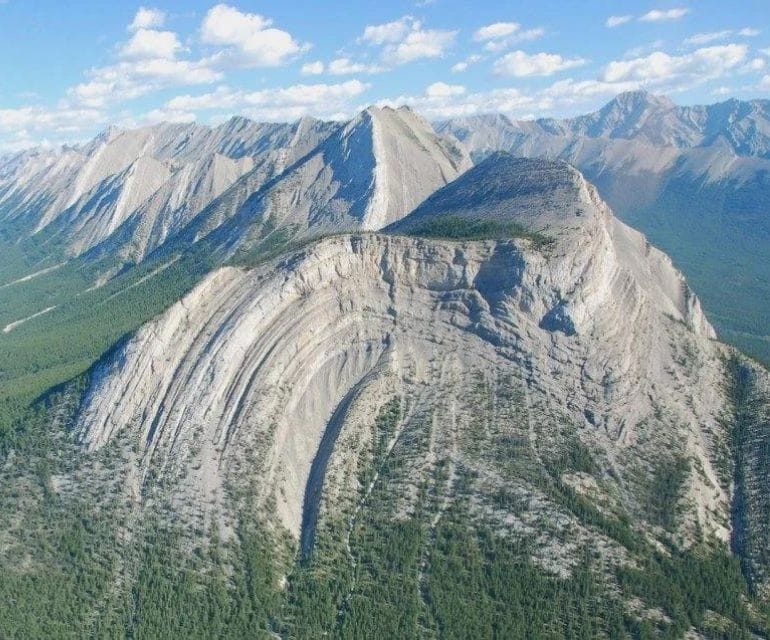
Mount Head in Alberta Canada
Look at those folds!
The seams in the rock you see above are part of The Folds found at Mount Head in Alberta Canada. These are caused by layers of rock that have been extensively folded due to tectonic forces.
These folds are a result of the immense pressure and heat within the Earth's crust that deform the rock layers over geologic time. Mt. Head is located in the Canadian Rockies, an area known for its dynamic geological history including the formation of mountains and folding events.
Geology highlights
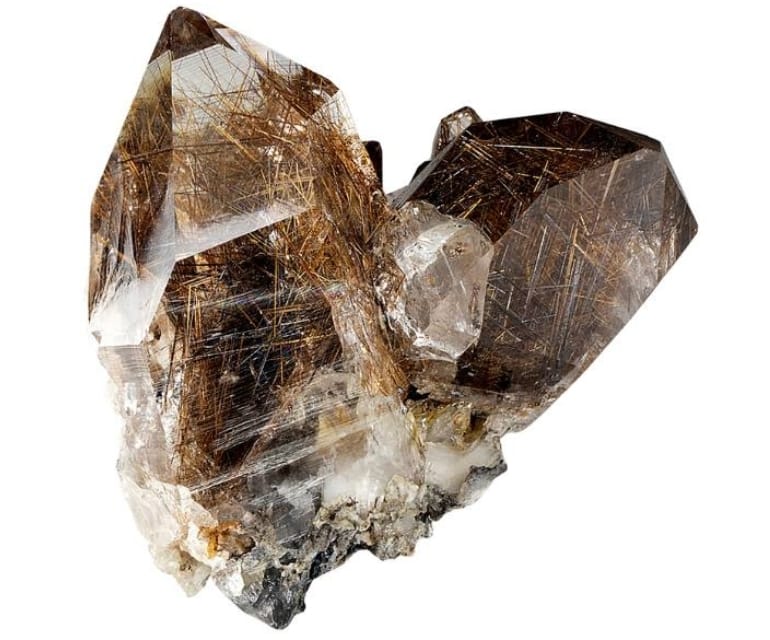
Rutile - Photo credit: Weinrich Minerals
I “Heart” rutile. This type of quartz is one of the most beautiful that I’ve ever seen up close. If you look closely you can see golden or reddish needle-like inclusions all through the clear quartz. It looks a bit like golden hair or thread.
The inclusions in the quartz are composed of titration dioxide and are randomly distributed throughout. It reminds me of a mini fireworks display or explosion!
Rutilated quartz like this can be found around the world but within the US is most often found in Georgia, Virginia, and the surrounding areas.

Geology Highlights

Two of the most commonly confused gem-quality crystals are garnets and rubies. High-quality garnet can look very similar to ruby and many less-than-ethical sellers have tried to pass garnet off as ruby over the years.
Fortunately, there are several ways that you can tell them apart, even without special equipment. We’ll dive into how to do that to ensure you aren’t getting duped and can make the right identification every time.
Both are beautiful in their own ways!